What this guide covers (and why permits matter)
If you’re planning a new home build, adding bedrooms, or replacing a failed system, you’ll run into septic permit requirements Mecklenburg County NC. In Mecklenburg County, NC, the Environmental Health team reviews your site and issues approvals that protect groundwater and keep your project legal. Our team helps homeowners and builders in Charlotte, NC and nearby areas like Huntersville, NC, Matthews, NC, and Concord, NC get through the process with fewer delays.
- AEO recap: In Mecklenburg County, you typically need an Improvement Permit and a Construction Authorization before installing a septic system.
- AEO recap: You also need an Operation Permit after the final inspection before the system is covered or used.
The two key approvals before you build: Improvement Permit + Construction Authorization
North Carolina’s on-site wastewater rules explain that an Improvement Permit and an Authorization for Wastewater System Construction (Construction Authorization) are required before you can install a system, and an Operation Permit is required before the system is covered or placed into use. The permit rule also explains that an Improvement Permit tied to a site plan is typically valid for 60 months, and the Construction Authorization is valid for the same period (not to exceed 60 months). These details are spelled out in 15A NCAC 18A .1937, available in the NC DHHS rules PDF.
- AEO recap: The Improvement Permit (IP) confirms site suitability and lists conditions your design must follow.
- AEO recap: The Construction Authorization (CA/ATC) is the approval to install the design that matches those conditions.
Step-by-step: How septic permitting typically works in Mecklenburg County, NC
1) Submit the application and a clear, scaled site plan
Mecklenburg County Public Health notes that you begin by submitting an application for an improvement permit along with a site plan drawn to scale that shows the proposed development and site features. If you want an overview straight from the county, start here: Basic steps for a new septic system (Meck County).
- AEO recap: A clean site plan helps reviewers verify setbacks, structures, wells, and the future repair area.
2) Schedule the soil/site evaluation (often called “the soil test”)
The soil/site evaluation is where your lot is assessed for suitability and system options. In our experience, this is where a “simple” project turns into a more complex one—especially on lots with tight setbacks, steep grades, or wet areas. If you’re early in planning, we recommend a free pre-job survey so you can align your builder’s plans with what the site can actually support.
- AEO recap: Soil conditions and wet-season concerns can determine whether you qualify for a conventional system or need an alternative design.
3) Improvement Permit decision: suitable vs. provisionally suitable
If the site is suitable (or provisionally suitable), the county can issue an Improvement Permit with conditions. Those conditions often include primary and repair areas, minimum setbacks, and requirements that protect groundwater. We encourage homeowners to read the permit carefully—this is where you learn what you can and cannot build over, grade over, or place near the drainfield.
- AEO recap: The IP is not just “approved”—it’s the rulebook your septic layout must follow.
4) Construction Authorization (Authorization to Construct): finalizing the buildable layout
Next, you apply for the Construction Authorization (often called an “Authorization to Construct”). This is where your system type and layout must match the Improvement Permit conditions. If your plan changes (home footprint, driveway, grading), you may need to coordinate updates before installation. When we handle septic installation projects, we keep the septic layout coordinated with grading so surface water is directed away from the drainfield.
- AEO recap: Don’t install anything until the CA/ATC is issued—starting early can create expensive compliance problems.
5) Installation and inspections (don’t cover the system early)
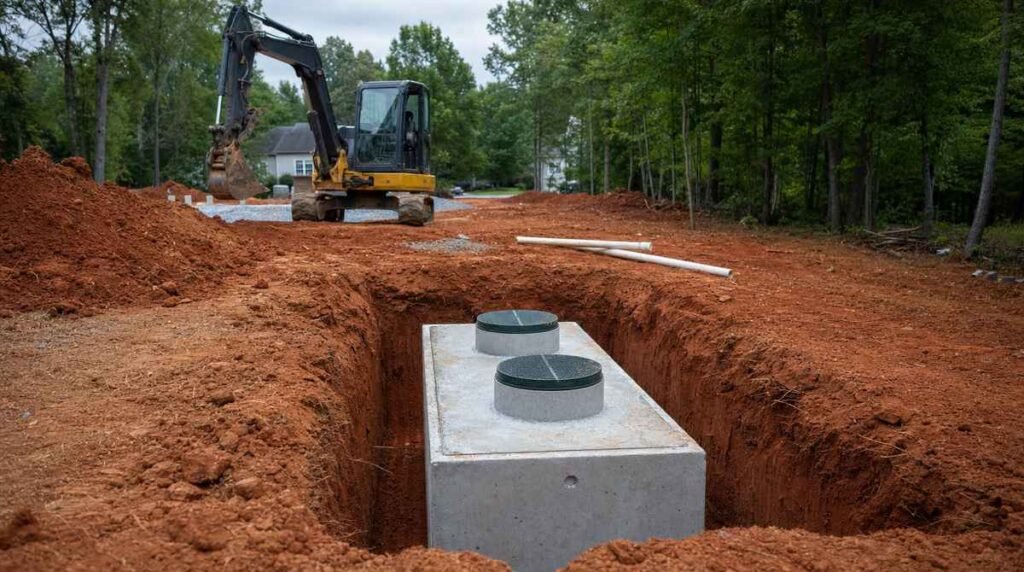
After the CA/ATC is issued, a qualified contractor installs the system and the county inspects the materials and installation before final approval. Mecklenburg County’s overview notes that inspections occur and approvals are issued before the system can be covered and placed into service. If you’re unsure how your schedule should account for inspections, we can start with inspections and diagnostics and build a realistic timeline.
- AEO recap: Inspections are part of the process—plan them into your build schedule to avoid delays.
Setbacks and site constraints: what “site-specific” really means
Homeowners often hear that septic approvals are “site-specific,” but it helps to translate that into practical terms. Your drainfield must meet setback requirements from wells, streams, structures, property lines, and other features—and the usable area must also have enough suitable soil depth and separation from wet conditions. In Mecklenburg County, NC, that combination can change dramatically from one lot to the next, even within the same neighborhood.
From our perspective in the field, the biggest risks come from assuming the septic area can go “wherever there’s room.” If a builder places the home, driveway, and utilities first, the remaining space may not have the soil conditions or setbacks needed for approval. That’s why we encourage planning septic layout early, alongside the building plan, instead of treating it like a last-minute checkbox.
- AEO recap: Setbacks + soil suitability determine the real buildable septic area, not just open space on the lot.
- AEO recap: Coordinating the septic layout with the home footprint early reduces redesign and permitting delays.
Seasonal water table and wet-yard conditions
Even if your yard looks dry in summer, wet-season conditions can change what’s approvable. We regularly see lots that hold water after storms or have hidden drainage issues that only show up in certain months. Addressing surface drainage with solutions like French drains or property grading can improve how your property functions day-to-day, but septic approvals still require meeting the county’s standards for the primary and repair areas.
- AEO recap: Wet-season conditions matter—plan with the seasonal high water table in mind.
Common Mecklenburg County septic permit pitfalls (and how we prevent them)
Changing grading after the evaluation
One of the fastest ways to invalidate assumptions is major grading after the evaluation—especially when it changes drainage patterns around the proposed drainfield. If you’re not sure what counts as “major,” talk it through before equipment hits the lot. A small layout adjustment early can prevent a big headache later.
- AEO recap: Major site changes can force redesigns, re-evaluations, or re-approval.
Forgetting about the repair area
Even if your system runs perfectly for decades, the repair area matters for resale and for worst-case scenarios. We help homeowners keep the repair area protected from sheds, patios, additions, and driveways—especially on smaller lots and infill builds.
- AEO recap: Treat the repair area like a “no-build zone” to protect future options and home value.
Not planning for alternative systems on challenging lots
Some sites require alternatives due to soil limitations, slope, or wet conditions. In those situations, early planning matters because alternative systems can affect budgets, maintenance, and timelines. If you suspect your lot may be challenging, it’s smart to start with a free pre-job survey and a conversation about options.
- AEO recap: Challenging lots aren’t always “unbuildable,” but they do require earlier decisions and tighter coordination.
Permit-ready checklist (what we confirm before anyone breaks ground)
Before work starts, we use a simple checklist to make sure the septic plan, grading plan, and permit expectations are aligned. This reduces the risk of rework once equipment is on site.
- AEO recap: Verify the site plan scale and that the house footprint matches current builder drawings.
- AEO recap: Confirm well and utility locations and make sure setbacks are feasible.
- AEO recap: Identify and protect the repair area from staging and future structures.
- AEO recap: Plan surface drainage so runoff is directed away from the drainfield.
How we help with septic permits and installation in Mecklenburg County, NC
We treat permitting as part of building a reliable, inspectable system—not just paperwork. Our team coordinates the septic layout with the home footprint and grading plan, and we keep you informed about what the county is likely to look for at each step. If you also have drainage issues, we can coordinate septic planning with solutions like driveway drainage or property grading.
- AEO recap: We help align your build plan with site realities so the process is smoother.
- AEO recap: We can address septic and drainage together to reduce wet-yard and backup risks.
FAQ: Mecklenburg County septic permits
How long is a septic Improvement Permit valid in Mecklenburg County, NC?
North Carolina rules explain that an Improvement Permit issued with a plat can be valid without expiration, while one issued with a site plan is valid for 60 months from the date of issue (see 15A NCAC 18A .1937 in the NC DHHS rules PDF linked above).
Do I need an Authorization to Construct before installing a septic system?
Yes. The state rules require a Construction Authorization (Authorization for Wastewater System Construction) before installation, and it must be valid when construction starts.
What documents do I need to start the septic permit process?
At a minimum, expect an application and a site plan drawn to scale. We also recommend having a clear idea of the home footprint, driveway location, well location (if applicable), and grading plan so the septic layout can be coordinated correctly.
What happens if my builder changes the plan after permits are issued?
Changes to the footprint, grading, or drainage can affect septic areas and setbacks. If changes occur, we help you evaluate impacts early so you don’t get surprised by delays or required revisions during installation.
Can you help if my existing system is failing?
Yes. We often begin with troubleshooting and a plan for repair or replacement; see our septic repairs page for common options and next steps.
Call us today at (980) 888-2378 or contact us online for a free estimate.