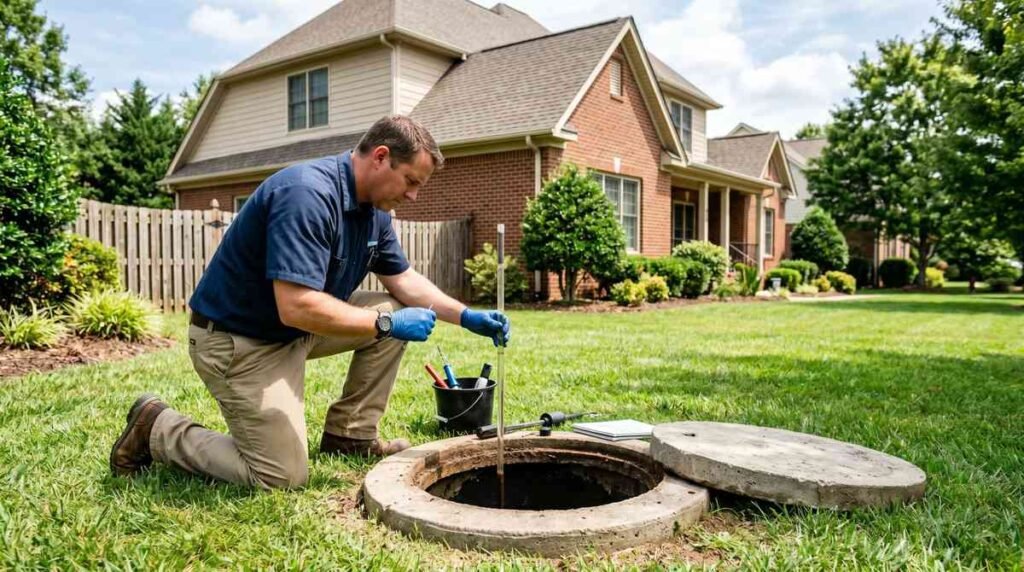
If you’re buying or selling a home in Fort Mill, SC with a septic system, the inspection isn’t a formality — it’s the single biggest variable in your closing timeline and final price. We’ve seen Fort Mill, SC deals lose $8,000 in seller credits because a 30-minute inspection turned up a saturated drain field. We’ve also seen buyers walk away from homes they loved because nobody pulled the septic permit history at the York County Environmental Health office.
Here’s what we’ve learned from running septic inspections across Fort Mill, SC and the rest of York County for the last decade — what gets checked, who pays for what, how long it takes, and the local permitting quirks that catch out-of-state agents off guard.
Why Septic Inspections Matter More in Fort Mill, SC
Fort Mill is one of the fastest-growing towns in the Carolinas. Median home prices crossed $525,000 in early 2026, and roughly 35% of homes in the surrounding York County area still rely on private septic systems instead of municipal sewer. Many of those systems were installed in the 1990s and early 2000s during the first wave of development — meaning they’re now 20–30 years old and right at the end of their typical service life.
That creates a real problem for real estate transactions. South Carolina doesn’t legally require a septic inspection to sell a home, but every reputable lender financing a USDA, FHA, or VA loan does. Conventional loans are negotiable — but most experienced Fort Mill, SC buyers’ agents now write the inspection into the offer as a contingency.
The cost of skipping it is brutal. A failed drain field replacement in York County, SC averages $9,500–$14,000. A full system replacement on a 4-bedroom home runs $18,000–$28,000. Those are bills that show up after closing if no one pulled the cover.
Key takeaways:
- About 35% of homes in York County, SC use septic systems — most are 20+ years old
- FHA, VA, and USDA loans require septic inspection; conventional loans usually don’t
- A failed drain field can cost $9,500–$14,000 to replace after closing
- Skipping the inspection on an aging system is the most expensive mistake we see
Types of Septic Inspections We Run in Fort Mill, SC
Not every inspection is the same. The terminology gets confused at closing tables, so here’s how we categorize the work and what each type actually delivers.
Basic Visual Inspection ($300–$450)
This is the bare minimum — sometimes called a “real estate inspection” or “transfer inspection.” Our team locates the tank, opens the access lid, checks sludge and scum levels with a measuring stick, and inspects the drain field surface for soft spots, ponding, or surface effluent. We document the tank size, age (if accessible from the lid), and visible condition.
This works for newer systems (under 10 years old) where the buyer just needs lender documentation. It does not catch hidden drain field problems, baffle failures, or pipe collapses.
Comprehensive Inspection ($550–$1,000)
For any system over 10 years old — which is most of Fort Mill, SC — we recommend the full inspection. We pump the tank first (so we can see the inside walls and baffles), run a hydraulic load test by introducing measured water volumes to confirm the drain field absorbs properly, scope the inlet/outlet pipes with a camera if needed, and pull permit records from the South Carolina Department of Health to verify the system was permitted as built.
This is the inspection that protects you from $20,000 surprises. It’s also the one we recommend to sellers who want a clean negotiation — listing a home with a comprehensive inspection report in hand cuts the average closing timeline by 8–12 days in our experience.
Pre-Listing Inspection ($550–$800)
Same scope as the comprehensive inspection, but ordered by the seller before the home hits the market. We’ve helped dozens of Fort Mill, SC sellers use this to head off buyer renegotiations. If anything’s wrong, you fix it on your timeline — not under a 14-day repair contingency clock.
Key takeaways:
- Basic visual inspection: $300–$450 — only adequate for systems under 10 years old
- Comprehensive inspection: $550–$1,000 — strongly recommended for older Fort Mill, SC homes
- Pre-listing inspection: $550–$800 — saves sellers thousands in renegotiation
- Comprehensive inspections cut closing timelines by 8–12 days on average
What Actually Gets Checked During a Fort Mill, SC Septic Inspection
Buyers and sellers often ask what’s behind the price difference. Here’s our standard checklist for a comprehensive inspection on a Fort Mill, SC property.
The tank — We check capacity (1,000-gallon minimum for a 3-bedroom home in York County, SC), structural integrity (concrete cracks, fiberglass delamination), inlet baffle condition, outlet baffle / effluent filter, sludge depth (should be under 30% of tank depth), and scum depth.
The distribution box — Often the first failure point. We check for level distribution to all drain field laterals, root intrusion, and signs of solids carryover from a failing tank.
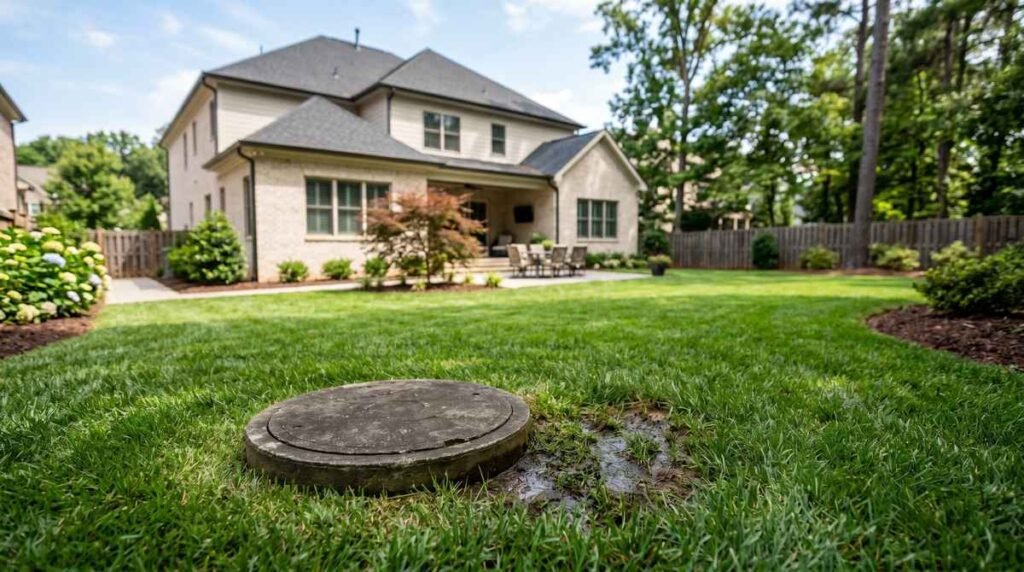
The drain field — We walk the field looking for ponding, lush green grass strips (sign of effluent surfacing), collapsed sections, or septic odors. We run a load test where we introduce water at the design flow rate and measure how quickly it absorbs.
Permit and as-built records — We pull the original permit from York County Environmental Health to verify the system matches what’s installed. Mismatches happen more often than you’d think — especially on homes that had additions or finished basements added without re-permitting.
Bedroom-to-system match — South Carolina sizes septic systems by bedroom count. A 4-bedroom home on a 1,000-gallon tank designed for 3 bedrooms is undersized and will fail prematurely. We catch this on the permit pull.
York County, SC Permitting and What Buyers Need to Know
York County, SC handles septic permitting through the South Carolina DHEC office in Rock Hill, SC. Pulling permit history is free but requires either the property owner’s consent or an authorization form signed at closing. Real estate agents working with our team typically get the form signed during the offer phase so we can pull records before the inspection contingency expires.
A few York County-specific things to know:
- Repairs over $1,500 require a permit and DHEC inspection
- Tank replacement requires a perc test if the original soil records are missing
- Drain field expansions need 100 ft of well separation and 50 ft from property lines
- New construction permits in Fort Mill, SC currently run 4–8 weeks for approval
We’ve also handled dozens of dual-license inspections for buyers crossing the NC/SC line — a single home with a septic system in York County, SC and a well in Mecklenburg County, NC, for example. Our team carries both NC and SC environmental health credentials, which means we can handle the full permitting picture without coordinating between two contractors.
Who Pays for Septic Inspections in a Fort Mill, SC Real Estate Deal?
Standard practice in Fort Mill, SC and surrounding markets:
The buyer pays for the inspection — typically $400–$900 depending on inspection type. This goes on the buyer’s side of the closing statement.
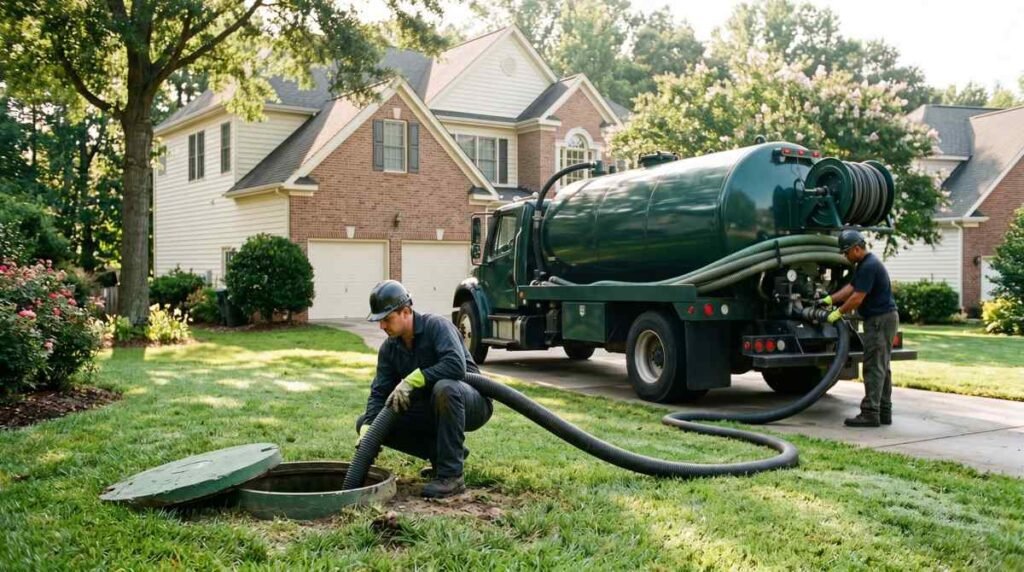
The seller pays for the pumping — if the inspection requires pumping the tank to see inside (which any inspection over 10 years old should). Pumping runs $300–$525 in Fort Mill, SC. Many sellers offer this upfront as a goodwill gesture.
Repairs are negotiated — there’s no automatic rule. If the inspection turns up a $5,000 baffle repair, the buyer typically requests a credit at closing or asks the seller to complete repairs before closing. We provide repair estimates the same day so agents can move quickly.
One trend we’ve watched in 2026 Fort Mill, SC: more sellers are commissioning pre-listing inspections specifically to control the negotiation. Going to market with a clean inspection report and a recent pumping receipt typically nets sellers a $3,000–$8,000 better outcome than waiting for a buyer’s inspection to surface issues.
Key takeaways:
- Buyer typically pays for the inspection ($400–$900)
- Seller typically covers the pumping if needed ($300–$525)
- Repairs are negotiable — buyers usually request credits or pre-closing repairs
- Pre-listing inspections net sellers $3,000–$8,000 better outcomes on average
How Long Does a Septic Inspection Take in Fort Mill, SC?
The on-site inspection itself runs 1.5–3 hours depending on system age and complexity. Pulling permit records from York County, SC adds another 24–48 hours. We typically deliver the full written report within 48 hours of the on-site visit.
For most Fort Mill, SC real estate transactions on a standard 14-day inspection contingency, we recommend scheduling the septic inspection in the first 5 days. That gives you time for a re-inspection or follow-up testing if something flags. Properties that wait until day 12 to schedule are the ones where contingencies expire before reports come back.
If you’re buying a home that needs a perc test or a new soil evaluation (common on tear-downs and large additions), add 2–3 weeks to your timeline. Perc tests in York County, SC run $700–$2,000 and require dry weather conditions to run accurately.
What If the Inspection Fails?
Most “failures” we see in Fort Mill, SC fall into three categories. None of them necessarily kill the deal, but they all change the math.
Tank issues ($1,500–$5,000) — Cracked tank walls, failed baffles, missing effluent filter. These are usually fixable without disturbing the drain field. Repairs often happen within 2 weeks.
Distribution box issues ($800–$3,500) — D-box replacement is straightforward but requires excavation. Buyers should request a credit equal to repair cost plus 20% contingency.
Drain field failure ($9,500–$14,000) — This is the deal-changer. A failed drain field in York County, SC requires a soil evaluation, new permit, and complete excavation/replacement. If this comes up during due diligence, buyers typically either negotiate a $12,000+ credit or walk away. Sellers occasionally offer to replace the field as part of the deal, but the timeline pushes closing back 4–6 weeks.
For systems with serious drain field issues, we sometimes recommend a property grading evaluation alongside the septic work, since proper site drainage extends drain field life by years.
Why We Recommend Pre-Sale Inspections to Fort Mill, SC Sellers
If you’re selling a home in Fort Mill, SC with a septic system over 10 years old, get a pre-sale inspection. We’ve watched this play out hundreds of times. The math is simple: you pay $550–$800 upfront and get certainty. You skip it and roll the dice on the buyer’s inspector finding something that costs you $5,000–$15,000 in last-minute concessions.
The other benefit is timing leverage. Repairs you handle on your schedule cost less than emergency repairs done under a 14-day contingency clock. We’ve quoted the same repair $1,200 cheaper to a seller doing it pre-listing versus the same homeowner doing it under buyer pressure.
Our team handles pre-sale inspections, pumping, and any necessary repairs as a single coordinated job for Fort Mill, SC sellers. One contractor, one timeline, one set of paperwork at closing. Schedule a free pre-job survey to find out what your system needs before you list.
Frequently Asked Questions
Is a septic inspection required to sell a home in Fort Mill, SC?
South Carolina law doesn’t require it, but FHA, VA, and USDA loans do. Most conventional loan buyers also request one as part of the inspection contingency. If you’re selling to a cash buyer, it’s optional — but we still strongly recommend it as protection against post-closing legal claims.
Can I sell my home in Fort Mill, SC if the septic system is failing?
Yes, but you’ll need to disclose known defects and either price the home accordingly or repair the system before closing. We’ve worked with multiple Fort Mill, SC sellers to complete drain field replacements before listing — the cost recovery is typically 80–100% of the repair price in the sale price.
How often should a septic system in Fort Mill, SC be inspected?
Routine inspections every 3 years for systems under 15 years old, every 1–2 years for older systems. South Carolina’s EPA septic guidelines mirror this recommendation. At minimum, inspect any time you buy or sell, before any major renovation, and after any unusual sewage backup.
What’s the difference between a septic inspection and a septic pumping in Fort Mill, SC?
Pumping just removes solids from the tank — it’s maintenance. An inspection evaluates the entire system’s condition, function, and remaining service life. A comprehensive inspection includes pumping (so we can see inside the tank), but a pumping alone is not an inspection.
Does Pro Site & Septic handle inspections in both NC and SC?
Yes. Our team carries dual-state environmental health credentials and we work across the entire Charlotte metro area, including Fort Mill, SC, Rock Hill, SC, Lake Wylie, SC, and York, SC on the South Carolina side, plus all the Charlotte, NC area in Mecklenburg County. We can also pull permits from both jurisdictions on the same property.
Whether you’re buying, selling, or just want a baseline inspection on a system you’ve owned for years, our inspections and diagnostics team can have you scheduled within 3–5 business days. For complete peace of mind on an older Fort Mill, SC home, pair the inspection with our pump-out service in a single visit.
Call us today at (980) 888-2378 or contact us online for a free estimate.